
How To Set Boundaries
Setting boundaries is a way to let your partner know how you want to be treated, what you are OK with, and what you are not OK with. All healthy relationships include some boundaries, that are known and understood by both parties.
- First you need to know how you want to be treated. Think about what has made you comfortable in the past, and what has made you uncomfortable. You need to be clear about what you want and what you don’t want before you begin a boundaries setting exercise. Boundaries affect the future of a relationship so be sure to talk about issues that are of real importance to you to keep the relationship healthy and happy. Don’t focus on trivial actions just to make a point, or to gain control over your partner, and don’t avoid actions that are important to you for your safety or your happiness and the future of the relationship.
- Work with one issue at a time. Choose something clear and fairly simple to start off with, until you get comfortable with setting boundaries, then move on to the tough stuff.
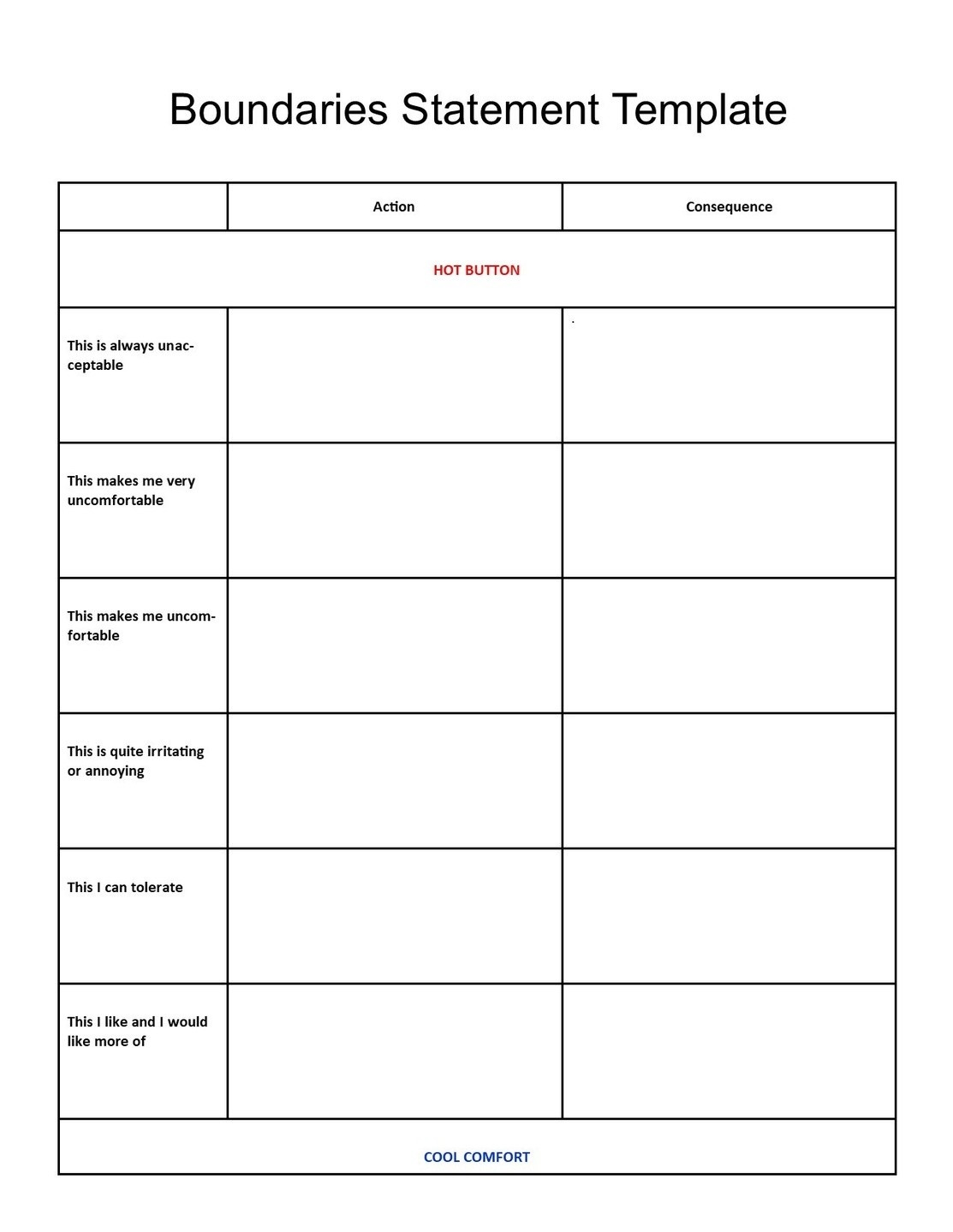
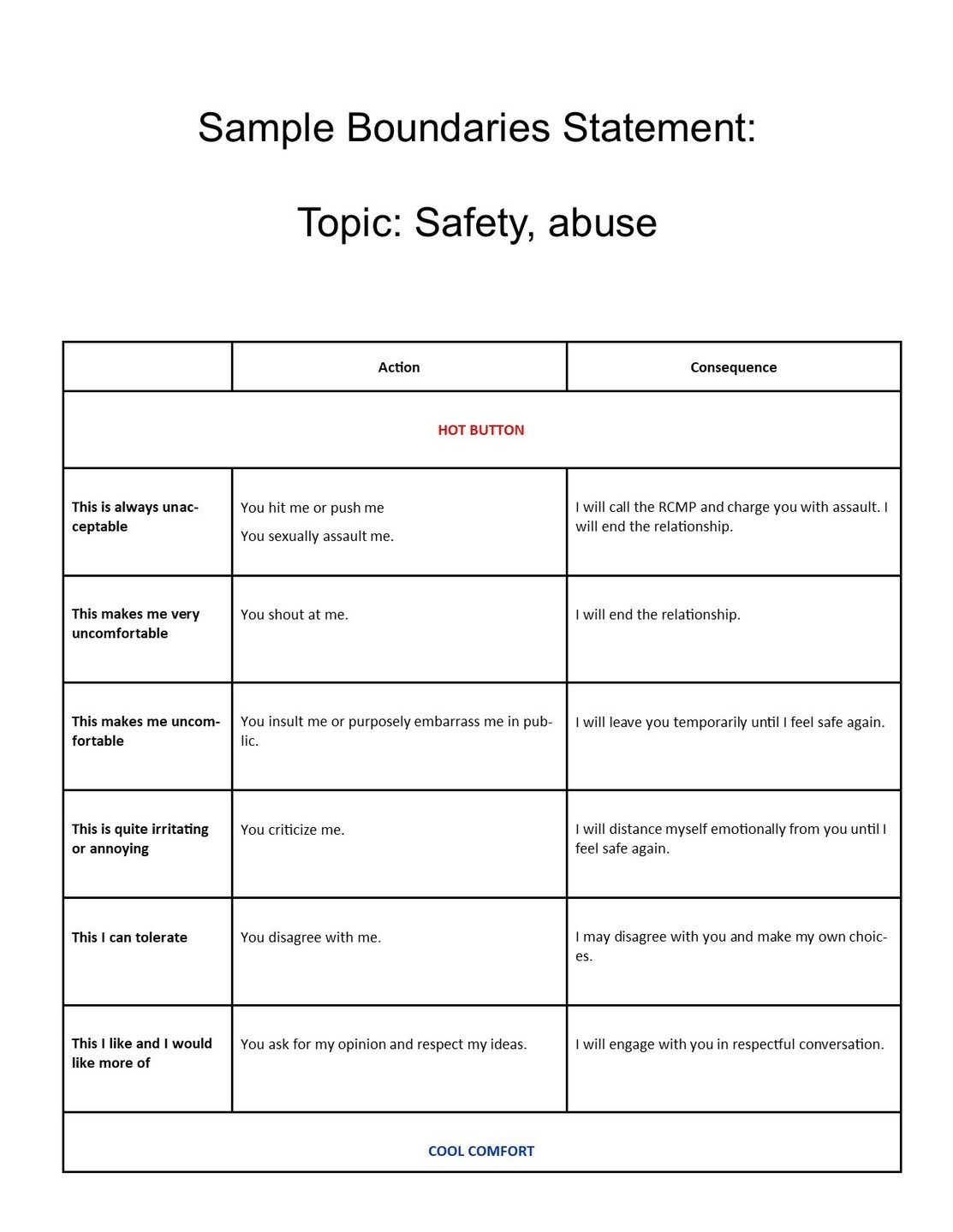
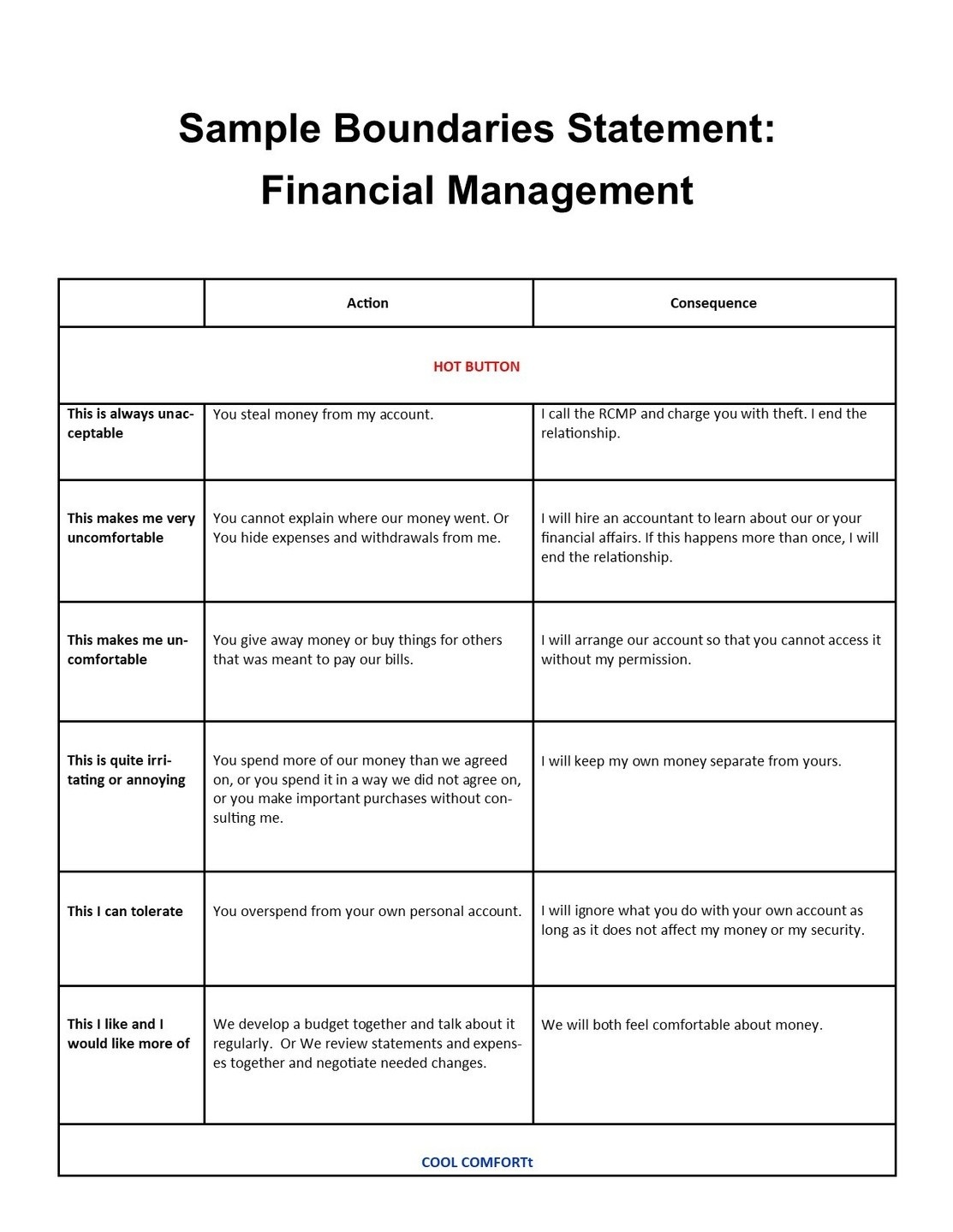
- Look at the worksheet on page 3. Think of your boundaries like a thermometer. At the top is the really HOT BUTTON stuff, the actions which are absolutely unacceptable to you under any circumstances, at any time. At the bottom will be the comfortable, COOL stuff. These are actions you can tolerate, and maybe would like more of. In between will be a number (try for at least 6) actions that move from cool “OK” actions through steps we might say are “annoying or irritating”, “uncomfortable”, and “very uncomfortable” to the hot “Unacceptable” end of the scale. There are some example boundaries statements on pages 4 and 5.
- Record the actions that you want to talk to your partner about on the left side of the worksheet. Be clear, specific, and use just a few words.
- The right side of the worksheet is for consequences. Remember that consequences can be either pleasant or unpleasant, rewarding or protective. In order to come up with useful consequences, ask your self these questions:
- “Is this a consequence that I actually can and am willing and able to carry out”? No point in making an empty threat you will never follow through on, that would just teach your partner that there are no consequences.
- “Will my partner see this as a consequence? Will it matter to him or her?” No point in setting a consequence that makes no difference to the other.
- “Does the consequence match the behaviour in size and severity and importance?” No point in making the consequence for a serious action so small it can be ignored, or making a consequence for a relatively unimportant action so severe that it breaks off the relationship.
- Think about “natural consequences”. In other words, what would be the likely natural outcome of pursuing an action? No point in talking about a consequence that does not follow naturally from the action.
- Develop your boundaries and consequences in private first. You will likely make several drafts before you are happy with your boundaries statement. Remember that once you present your boundaries to your partner, you will have made a strong statement about the future of the relationship so be sure you are certain before proceeding. Your partner should do the same.
- When you are both ready, share your boundaries statements. Use the communication guidelines on page 7 to share your boundaries.
- When your partner shares his or her boundaries with you, it is OK to ask for clarification so you understand. But there is no room for negotiating or disagreeing with your partner’s boundaries.
- Once you understand your partner’s boundaries, you have two choices: either respect them or do not respect them. If you choose to not respect your partner’s boundaries, you can expect that your partner will exercise the promised consequences.
- Once you have set your boundaries, relax. Do not nag your partner about what she or he has done in the past or might do in the future. Avoid bringing up the subject unless your partner chooses to not respect your boundaries.
- If your partner chooses to not respect your boundaries, be sure to exercise the promised consequences, or you will teach your partner there are no consequences and the relationship will not be healthy. If you do not follow through on the consequence you stated, you may be at greater risk, if the relationship is abusive.
- Review your boundaries every few months, to see if they are still relevant and important to you. It is OK to change your mind about your boundaries, if they no longer work for you. Share your new boundary with your partner. Avoid being a see-saw and making frequent changes, and avoid changing your mind for no good reason.
Guidelines for Delivering Boundaries Statements
Step 1: "I Observe"
- I see - I notice
- I hear - I observe
- I smell - I perceive
- I taste - I sense
- I touch - I pick up
Step 2: "I Think"
- I judge - in my opinion
- I interpret - my thoughts are
- I wonder - I am curious to know
- I translate that to mean - I take it you mean
- I agree - I disagree
- I predict
Step 3: "I Feel"
- proud - lonely
- sad - scared
- happy - joyful
- unsure - confused
- angry - frustrated
- loving - protective
- wary - secure
- worried - safe
Step 4: "I want"
- I want - I don't want
- I want more of - I want less of
- I am willing to - I am not willing to
- I agree to - I do not agree to
- I consent to - I do not consent to
- I would like to - I would not like to
- I will do - I will not do
Step 5: “I Intend”
If you respect my boundaries, I will…..
- If you do not respect my boundaries, I will…
- Follow though on the promised consequences
- Ask the person you are communicating with to share their own thoughts and feelings, using the same formula for communication
|