
Tools and Resources

Our Policy on the Use of Resources
This library is constantly being updated, so check back frequently for new resources.
Looking for something you don't see here? Contact us here to ask for a new resource.
If you encounter any difficulties downloading, please contact us.
All of the documents I have created are copyrighted, so, while you are welcome to use them yourself, I ask that you respect my professional experience, my need to earn a living (I have a mortgage to pay, too!) and copyright law by doing the following:
- Do not use my materials for any financial gain. Do not sell them to clients, and do not incorporate them into your own or your agency's resources to line your pockets or your agency's bank account.
- Do not distribute any of my resources to anyone outside of your own immediate organization. By all means show them to your co-workers if they would be of use for helping clients. But please do not send them out to any other office, organization, board or agency, to the media, or to the public. If there is something you really like and want to make wider use of, please ask me for the rights to do so.
- Do not use my resources for training your staff. If you need staff training, I can provide a custom training program just for your organization, or encourage them to register for my next course offering. For information about courses, please consult our on-line courses.
Resources for Supporting Women in Abusive Relationships
These resources will help to support her while she manages her life and maybe creates a better life, free from abuse.

How Can I Make Safety Plan?
Not sure how to stay safe? This plan will help.
https://seawinds-education.mykajabi.com/how-can-i-make-a-safety-plan
The Cycle of Violence
Unfortunately, it's predictable, there is a pattern. Staying safe is easier if you understand the cycle and can predict what's coming next.
https://seawinds-education.mykajabi.com/the-cycle-of-violence
Five Types of Trauma Bonding
There is a solid reason why it is so challenging to leave an abusive relationship: it is possible to become addicted to both the abuse and the abuser.
https://seawinds-education.mykajabi.com/5-types-of-trauma-bonding
Why Is It so Challenging To Leave?
There are many reasons why. It is just not as simple as "just go!" This video outlines some of the many reasons.
How to Set Boundaries
Setting boundaries can be the first step to deciding if the relationship can be recreated. If the abuser refuses to honour them, it's time to leave.
https://seawinds-education.mykajabi.com/how-to-set-boundaries
Triage Tool For Supporting a Woman Escaping a Violent Relationship
Not sure what to do first? Or next? This tool will help you organize yourself to support her and meet her needs at each stage of her escape.
Want To Learn More?
Seawinds Education offers two on-line courses for further study. "The Breakout Pro" helps women who are stuck find ways to free themselves of abusive relationships, for good. "The Breakout Pro for Frontline Workers" is for helpers who want to be effective in supporting women experiencing abuse at home.
Contact us for future course dates.
To Register:
The Breakout Pro: How Smart Professional Women Break Free from Abusive Relationships: https://seawinds-education.mykajabi.com/offers/pMELzmmT
The Breakout Pro for Frontline Workers: https://seawinds-education.mykajabi.com/offers/F6mAZNff
Tools to Improve Communication and Relationships
Want your relationship to be the best it can be? These resources can help.

The Five Easy Steps For Talking About The Tough Stuff
A simple, easy to use formula for talking about just about anything. The go-to guide for assertive speaking.
https://seawinds-education.mykajabi.com/the-5-easy-steps-for-talking-about-the-tough-stuff
Common Thinking Errors
A summary of those familiar traps we all fall into sometimes. Some common irrational jumps we make away from clarity, passiveness or aggressiveness.
https://seawinds-education.mykajabi.com/common-thinking-errors
How to Set Boundaries
All healthy relationships have boundaries, most of which are unspoken. Sometimes it is important to craft careful boundaries to reshape or challenge a tough relationship.
https://seawinds-education.mykajabi.com/how-to-set-boundaries
Guidelines for Active Listening
- Give your complete attention. Show respect, acceptance, empathy.
- To build trust, let the other person set the pace. Don't push faster or further than the person wants to go.
- Be patient. Allow plenty of time and do not interrupt.
- Don’t be afraid to simply hold silence.
- Do not argue or criticize, as it is likely to cause the other person to clam up or become angry. Even if you "win", you lose.
- Don't feel you have to "solve the problem". The best solutions usually come from the person with the problem. Focus instead on acknowledging what you have seen and heard.
- Listen to what the other person is saying and how they are saying it.
- Watch for non-verbal cues to the person's feelings. Use your eyes as well as your ears for listening.
- Do not avoid the “tough stuff”.
- Be aware of both the facts and the feelings in what your client is saying.
- Reply using your own words to describe what you have heard.
- Be honest. Let the other person know if you don't understand something they say to you.
- Keep focused on listening. The best way to do this is to stop talking yourself!
Guidelines For Asking Useful Questions
- Do I really need to ask a question right now? Can I use some other communication tool instead?
- By asking a question, am I trying give a message that is better not given?
- What other alternatives can I use?
- Would a closed or an open-ended question help the conversation more right now?
Effective Paraphrasing and Reflection of Feelings
- Acknowledge the most important part of the message.
- Keep the focus on the speaker, not on someone else.
- Probe for deeper meanings.
- Listen for what is not said.
- Combine interest in both facts and details, and on emotions and personal impacts for a well-rounded response.
- Focus mostly on the emotions in a therapeutic conversation.
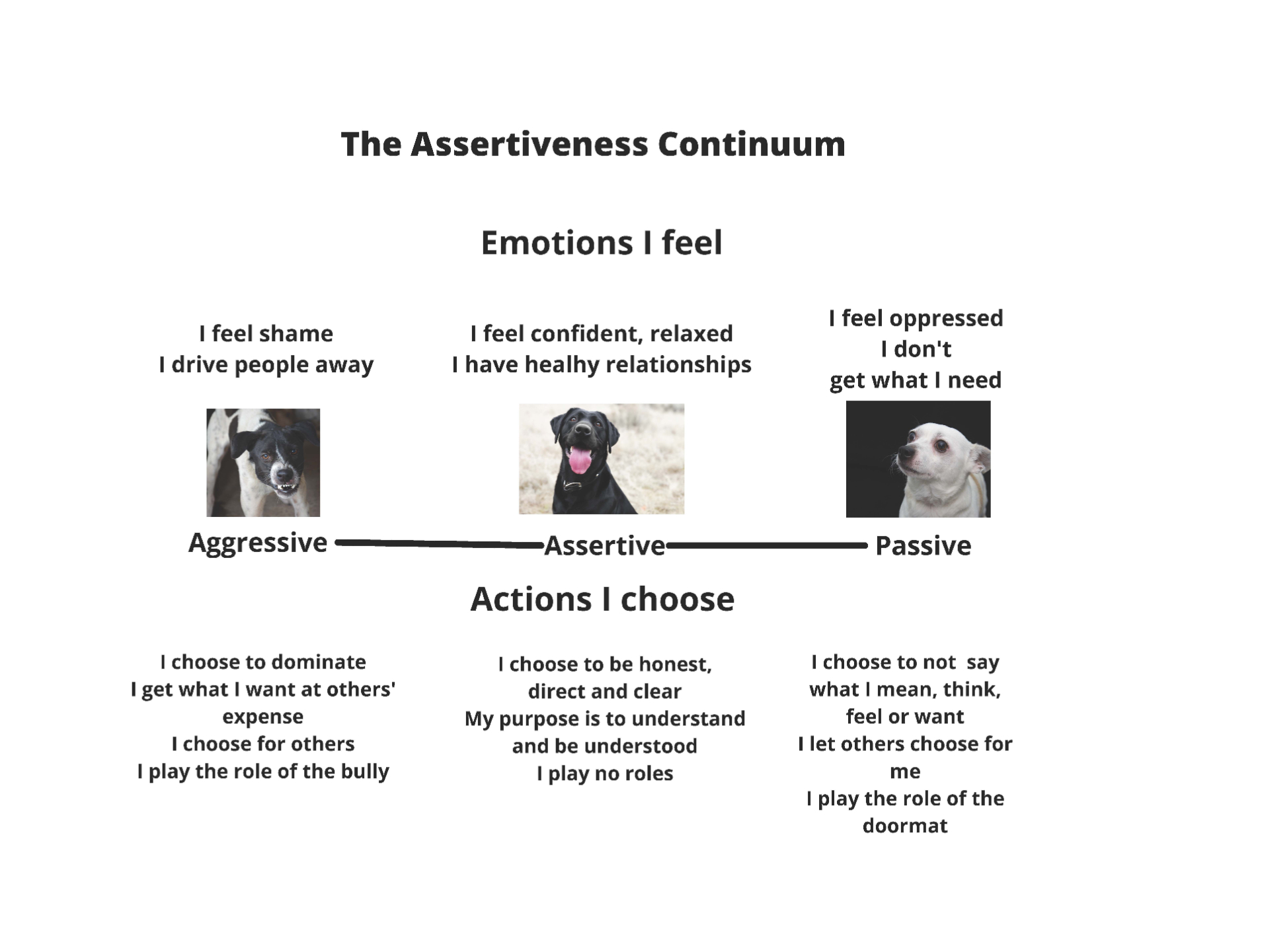
What is Assertiveness?
What Does A Healthy Relationship Look Like?
|
Your partner values what you have to say. |
|
|
Your partner asks your opinion, and listens when you tell him your opinion. |
|
|
Your partner thinks you are a good person, and tells you so, often. |
|
|
Your partner values your skills, both at home and at work, and thanks you for your contributions to the home and family life. |
|
|
Your partner is polite to your friends, even if he does not like them. |
|
|
Your partner speaks to you with no hostility in voice or body language. |
|
|
Your partner does things to protect you, care for you, make your life better. |
|
|
You know for sure you will be welcomed warmly when you come home. |
|
|
Your partner asks you what you want and need and then does what he can to do those things for you. |
|
|
Your partner is kind to you. |
|
|
Your partner likes you and your values about how to treat people. |
|
|
Your partner follows through on promises to you. |
|
|
Your partner wants for you to be happy. |
|
|
You both enjoy having sex, and have sex regularly at times that work for both of you. |
|
|
Most of the time, you have lots of positive feelings for your partner. |
|
|
Usually, you both look for solutions to issues rather than blaming or finding fault. |
|
|
You and your partner both look for opportunities to be affectionate. |
|
|
As parents, you are both lovers and partners. |
|
|
You can communicate honestly. No lying, deception, secrets, frequent arguments. |
|
|
You can both let go of the past and focus on the present. |
|
|
You like looking after each other’s needs. |
|
|
You are in the relationship because you want to be, not for obligation. |
|
|
You like living together. |
|
|
Your visions for the future are similar. |
|
|
Your values about how other people should be treated are similar. |
|
|
You have a workable arrangement for handling money, which both of you honour. |
|
|
You are not afraid of your partner. Ever. |
|
|
When you and your partner have disagreements, you can talk about them kindly. When you have strong disagreements, you both fight fairly. |
|
|
You have similar ideas about how to raise children and can talk about how to do so without stress or disrespect. |
|
|
You and your partner are able to create mutually-agreeable plans for your future. |
|
|
Your partner respects your boundaries. |
|
|
You and your partner appreciate each other’s sense of humour. |
|
|
You and your partner are able to share your deepest emotions. |
|
|
You and your partner both trust the other to a significant degree. |
|
|
You enjoy each other’s companionship, and enjoy doing at least some things together, while respecting each other’s needs for privacy. You are able to create a balance between togetherness and individuality that works for both of you. |
|
|
You and your partner are able to be honest with each other and trust each other to be truthful. |
|
|
You are both able to compromise on occasion without giving up your most important needs. |
|
|
You each have your own identity, which does not depend on your partner’s. |
|
|
You and your partner both support the other to pursue new hobbies and make new friends. |
|
|
Neither of you is dependent on the other to the point where you cannot function without the other. |
|
|
You each make the other feel loved, wanted, and appreciated. You feel valued, accepted. You feel a deep emotional connection. |
|
|
You are able to spend quality time together regularly. |
|
|
You have fun together. |
|
|
You have relationship rules, or boundaries, which you both understand and commit to. |
|
Am I In An Abusive Relationship?
My partner has threatened me, my children, or some other family member, or my pets with violence.
My partner has pushed, shoved or tripped me purposely.
My partner has hit, bit, kicked, or punched me.
My partner has cut, burned, or used a weapon against me.
My partner has tortured or mutilated me.
My partner has yelled at me.
My partner has called me names, insulted me, mocked me, humiliated me, or used abusive language against me, in public or in private.
My partner has prevented me from seeing my friends and family.
My partner has treated me with contempt or emotional coldness, or my partner has isolated me from meaningful contact.
My partner has raped me or threatened to rape me.
My partner has touched me sexually without my consent, forced me to engage in sexual activity against my will or forced me to have sex without contraception.
My partner has deliberately given me a sexual illness or infection.
My partner has controlled my finances or my income, or my money has been taken without my permission.
My partner has controlled access to my financial information or records.
My partner has prevented me from getting a job that would bring in my own money.
My partner has forced me out of my house, or forced me to give away control of my house.
My partner has not given me medical help when I needed it.
My partner has not provided me with food or basic necessities of life when I needed them.
My partner has done other things that were meant to control, belittle, hurt or deprive me.
Are My Children Being Abused?
My child has witnessed or heard a parent being abused.
My partner treats my children as if they were a possession, or as if they exist for his benefit.
My partner constantly criticizes my children or makes them feel bad about themselves on purpose.
My partner tells my children they are stupid or worthless or will never amount to anything.
My partner tells my children they are stupid or worthless or will never amount to anything.
My partner ignores or neglects my children.
My partner deliberately withholds food, medical care, or other necessities of life from my children.
My partner threatens to abandon my children or leave them behind.
My children have been forced to watch porn or sexual activity, to take off their clothes or watch someone else undress, or have nude photos taken.
My children have been forced to touch someone’s genitals or to allow someone to touch theirs.
My children have been forced or enticed to have sex with an adult or with another child.
My children have been kept in the home and not allowed to leave or not allowed to see family or friends.
My children are constantly watched, monitored, or controlled, including phone and internet activities, beyond the requirements of safety.
My partner has engaged in any other activity meant to control, belittle or in any way harm my children.
Want to Learn More?
Mind Over Mood: Change How You Feel By Changing The Way You Think. Christine Padesky and Richard Greenberger. This is a very popular workbook, published in more than 20 languages, millions of copies sold worldwide. Our emotions are created directly by what we think, so let's examine what we think.
Tools For Destressing
These resources will help you unwind and create a new you.

Relaxation Recording
Time to chill out? Settle back and allow yourself to destress with this recording.
https://seawinds-education.mykajabi.com/relaxation-recording-10ba0b5c-a5a0-4d80-977f-9cb5135704b3
Calm Yourself Down
Don't want to be at the mercy of your strong emotions? Try these techniques to calm yourself down.
Did you know we have 3 nervous systems?
The central nervous system is the one we don’t need to think about. It runs our brain, heart, digestion and other body functions. The autonomic nervous system is all about our emotions. It has 2 branches – the sympathetic system and the parasympathetic system.
The sympathetic system is the one activated when we feel love, joy, pleasure, excitement, and also when we feel anxiety, fear, anger, frustration.
The parasympathetic system is the “calm down” system. It is the one that we engage when we relax.
The two branches are biphasic and bipolar. In other words, they cannot both be activated at the same time. If the parasympathetic nervous system is dominant, then the sympathetic is down. If the sympathetic is up, then the parasympathetic system is down. That’s good news, because it means that we can actively do something to calm down when we feel distress.
So here’s the thing that matters: It is impossible for a body, in which every single muscle is relaxed, to feel distress. It’s really pretty simple, not always easy to do in practice, but with practice, it is quite wonderful.
One of the reasons why all of these suggested calm-down exercises works is that they all engage at least one of our 5 senses – sight, hearing, touch, taste and smell. The 5 senses are directly connected to the parasympathetic nervous system, the calm down system. So – you want to relax? Engage your 5 senses.
These exercises all help the parasympathetic system to be dominant, thus squelching the sympathetic system and dampening our emotional feelings. Which are the most effective? Which ever ones work best for you. You can combine them for even better effect. For example, the jaw drop and the pelvic floor drop, followed by the diaphragmatic breathing is a popular combination. Or the peripheral vision and wet noodle is another popular combination.
Experiment with these. Try out all of them to discover which work the best for you. Then practice them about 10,000 times a day. Any time you feel a negative thought enter your consciousness, relax. Anytime you feel some distress rising, relax. Anytime you think about it, relax. Once every few minutes, relax, whether you need to or not. In a couple of weeks of using these skills often, your body will start to figure out what to do, and it will become easier, faster, and lead to deeper relaxation.
1. The 5 Senses Inventory
Take a mental inventory of 5 things you can see around you, and list them. (“I see desk, I see lamp, I see carpet…”etc.)
Take a mental inventory of 4 things you can feel. (“I feel my shoes, I feel my bum on the chair, I feel my earrings…”)
Take a mental inventory of 3 things you can hear (“I hear a car on the road, I hear my fridge…”)
If you need more time, do it all again with 5 more things you can see, 4 more things you can feel, 3 more things you can hear.
2. The Wet Noodle
Scan your body. Start at the top of your head and go right down to your toes. Find any muscle that is tight, scrunch it up and hold for 10 seconds, then let it go. Try tightening up all your muscles then letting them go to find the feeling of total relaxation.
3. Find Your Peripheral Vision
Focus on a spot on the wall straight ahead.
Keep your focus on that spot, but allow your field of view to widen and notice what you see in your peripheral vision.
You can hold your hands beside your ears and slowly extend them, keep your focus on the initial spot ahead of you but allow your peripheral vision to follow your hands.
Do this for 10 seconds.
4. The Eye Roll
If your distress level is at about a level 1 or a 2 out of 10 (0 = no distress at all; 10 = the worst you can possibly imagine) this one will work for you. Look at the floor. Then very slowly raise your eyes until you are looking straight up at the ceiling. Hold it for a few seconds then relax. You will probably find yourself at a zero level of distress.
You can do this one again if the first attempt did not lower your distress level enough.
5. Relax Your Jaw
Gently allow your jaw to drop towards the floor.
Drop your tongue. Get it off the roof of your mouth and let it touch your bottom teeth.
Try to drop the roof of your mouth.
Hold for 10 seconds.
6. Relax Your Pelvis
Sit on your hands, dig around and find two bony points that stick down out of your pelvis into the seat cushion. Put pressure on those 2 spots for 10 seconds, until your body has a felt sense of them.
Sitting or standing, find the top of the widest part of your pelvic bones on both sides and press on them. Hold that sensation of feeling.
Draw imaginary lines or pieces of string to connect those 4 points. The left front hip point to the right front hip point; right front hip to right butt cheek point; right butt cheek point to left butt cheek point; left butt cheek point to left front hip point. That forms a rectangle with one side higher, so it forms a rectangle on a 450
Focus on the edges of the rectangle, the boundaries, and softly expand the rectangle outwards.
Relax the core muscles in the middle of the square.
Tighten up all the muscles you would use to try to not pee or poop. Hold them tight for 5 seconds then relax.
Everything will relax along with them.
7. Deep Diaphramatic Breathing
Breathe deeply, as if you were breathing to your toes.
Slow your breathing down, while continuing to breathe deeply.
Lengthen the exhale to be about twice as long as the inhale. Try counting:
- In, 2, 3, 4
- Hold, 2, 3, 4
- Out, 2, 3, 4, 5, 6, 7, 8.
- In, 2, 3, 4
- Hold 2, 3, 4
- Out, 2, 3, 4, 5, 6, 7, 8.
Continue breathing deeply and consciously.
Which ones work the best for you?
Tools for Helpers
These tools are of interest to those who listen therapeutically.
Triage Tool for Trauma
This tool guides helpers supporting someone who has experienced a trauma.
See the triage tool hereTriage Tool For Suicide
This tool guides helpers when suicide has been mentioned.
View the triage tool hereTriage Tool for Intimate Partner Violence
This tool guides helpers supporting a woman in or escaping from an abusive relationship.
See the triage tool hereInterview with Mary Desmond
A much respected African American elder, author and community activist, Mary Desmond was formerly a nurse working in corrections. In the video above, Mary offers advice to non black helpers for supporting black clients.
Want to Learn More?
The Non-Therapist: How To Help As If You Were a Pro. Kate Tompkins. This book will become your favoured go-to guide for therapeutic listening. For anyone who did not receive any formal training in counselling skills, or it was ages ago, but find themselves counselling anyway.
Interview With Mary Desmond
A much respected African Canadian community advocate, Mary was formerly a nurse working in corrections. In this video, she offers advice to non-black helpers wanting to support black clients.